As we preview the GTIA State of the Channel 2026 research, one theme rises above the rest: The industry has entered a true AI inflection point—one where adoption is no longer a differentiator, but maturity is. Growth remains steady yet intentionally measured, reflecting a market where discipline and execution separate leaders from those falling behind. And despite predictions of consolidation, the channel continues to operate as a hybrid ecosystem, defined more by complex business models than convergence. This year’s findings capture a channel not just evolving, but sharpening its focus as it moves from inflection to execution.
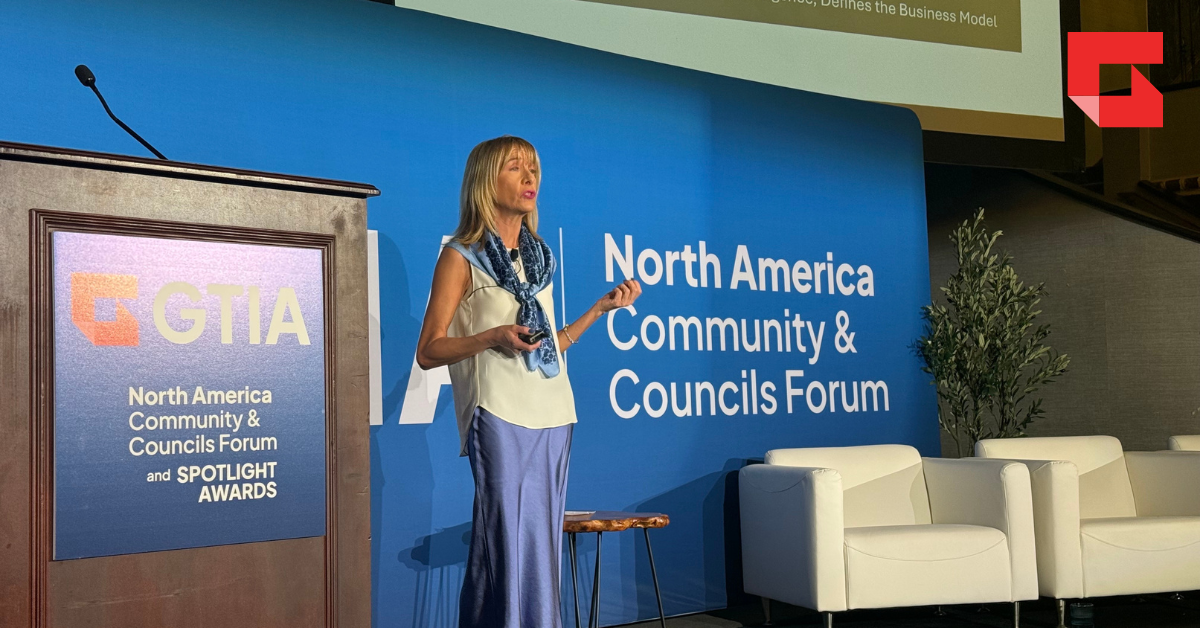
Carolyn April, vice president of research and market intelligence at GTIA, unpacked the findings at the GTIA North America Community & Councils Forum in Chicago.
By the Numbers: A Snapshot of Channel Reality
- Half of ITSPs view tech’s growing complexity as the No. 1 driver for channel demand
- 75% of ITSPs describe their businesses as “AI-driven” or “AI-invested”
- No. 1 revenue driver for next two years: AI services
- 46% of ITSPs ahead of their annual business goals describe themselves as “AI-driven”
- 54% fewer ITSPs are “very satisfied” with vendor relationships compared with last year
- 49% of ITSPs say their business remains a mix of project/product sales and recurring revenue
The Channel’s Pulse: Stable or Rapidly Changing?
This year’s research reveals a split mindset: Some ITSPs see the channel as relevant and stable, while others view it as relevant but rapidly transforming. The implication for vendors? “You’re serving two different communities at any given time, which adds another layer of complexity,” April said.
What’s Strengthening the Channel
- 58%: Tech’s growing complexity drives demand
- 49%: Adoption of GenAI tools
- 49%: Increased demand for cybersecurity services
>> GTIA members: Access Channel Trends in Cybersecurity on the Member Portal.
What’s Challenging the Channel
- 44%: External factors
- 37%: Workforce skills shortages
- 30%: Competition from online marketplaces
“My only advice when it comes to navigating external factors is to try to build a business that’s already resilient,” April said. “Companies that have a good balance sheet, healthy cash flow and are prepared for the proverbial rainy day, are the companies that make it and can weather these external factors. It’s an advertisement for good basic operational practices.”
In fact, more ITSPs report being on target in 2026, but fewer are outperforming their own expectations. “These are good numbers, and it’s good to see that most of the companies we are talking to feel that they are on target,” April said.
Business Models: Hybrid Dominance and the Coming AI Shift
While AI-driven business model transformation is on the horizon, most ITSPs today still describe themselves as core technology services providers. “We’re not seeing one operating model dominating,” April said. “The business model for AI is still to be discovered—and there will probably be more than one.”
While AI is expected to grow the most over the next two years, April notes that infrastructure still pays the bills.
Top Revenue-Producing Offerings Today
- 58%: General consulting
- 56%: Data services
- 51%: App dev services
- 51%: Cloud services
- 46%: Integration services
The research shows that growth priorities remain consistent year-over-year in terms of categories, but expectations have moderated as ITSPs recalibrate forecasts amid cost pressure, market uncertainty and maturing demand. “There is still healthy growth expectations in these areas,” April said. “But they are slightly softened year over year. It’s nothing to be alarmed about, it’s more of a natural resetting that we’re seeing in the market.”
AI’s First Big Impact: Internal Operations
The first wave of AI adoption is happening internally. Every survey respondent reported using AI—but only 20% say they have strategic, formalized AI adoption. “The only way we’ll be successful selling AI solutions is if we can be successful internally running your business better,” April said.
Where ITSPs Stand on the AI Spectrum
- 28% AI-Driven: Prioritizing AI internally and in customer offerings
- 47% AI-Invested: Using AI operationally and offering some AI services
- 23% AI-Curious: Experimenting but still unclear on use cases and costs
- 3% AI-Phobic: No plans for integration
Movement between these groups, April noted, is a business decision, not a technology one. Today, AI is most often applied to reducing technical debt (coding, development) and creative debt (content, marketing). The true differentiator? A strategic adoption plan, not tool usage alone.
“The difference between companies that are effective with individual tools is the strategic plan you have around these tools for every single one of your employees.”
Monetizing AI: Early Days with Measured Expectations
AI revenue is emerging, but growth remains modest—and appropriately so. ITSPs in strong operating health are leaning most aggressively into AI, showing that AI investment intensifies the gap between leaders and laggards. Cybersecurity challenges remain top of mind, with 39% citing them as a primary concern. “AI is both your best friend and your enemy,” April said, noting that attackers have access to the same tools. Human error and poor training introduce additional vulnerability—creating ongoing opportunity for ITSPs to guide customers safely.
Vendor Relationships: Shifting Priorities
While the number of partner programs ITSPs participate in hasn’t changed dramatically, participation at the high end is decreasing. Churn is rising as firms evaluate partners against new priorities. Most ITSPs now belong to 5–15 program ecosystems. Satisfaction is increasingly tied to vendor alignment rather than performance: Four in 10 firms ahead of goals are very satisfied with their vendors. “It’s not about vendors failing,” April said. “It’s about alignment… It’s not about selling products, it’s about selling their brand and their expertise.”
Operational Discipline: The New Competitive Edge
In the current market, operational soundness matters more than anything else. Strong financial fundamentals, clear KPIs, robust forecasting and consistent sales and marketing processes are what enable flexibility—and resilience.
April emphasized that peer collaboration also plays a crucial role. Connecting with others provides a safe space to learn, ask questions and refine operational practices. “This is why being involved with your peers is so important,” she said. “This is where you learn, exchange ideas and not be afraid to ask questions.”
Dan Wensley, GTIA CEO, had advice for the crowd as well: “If you want to be great, take this data and turn it into your own data for your customers."
GTIA Members: Access the GTIA State of the Channel 2026 on the Member Portal.
Not a member yet? Join now.