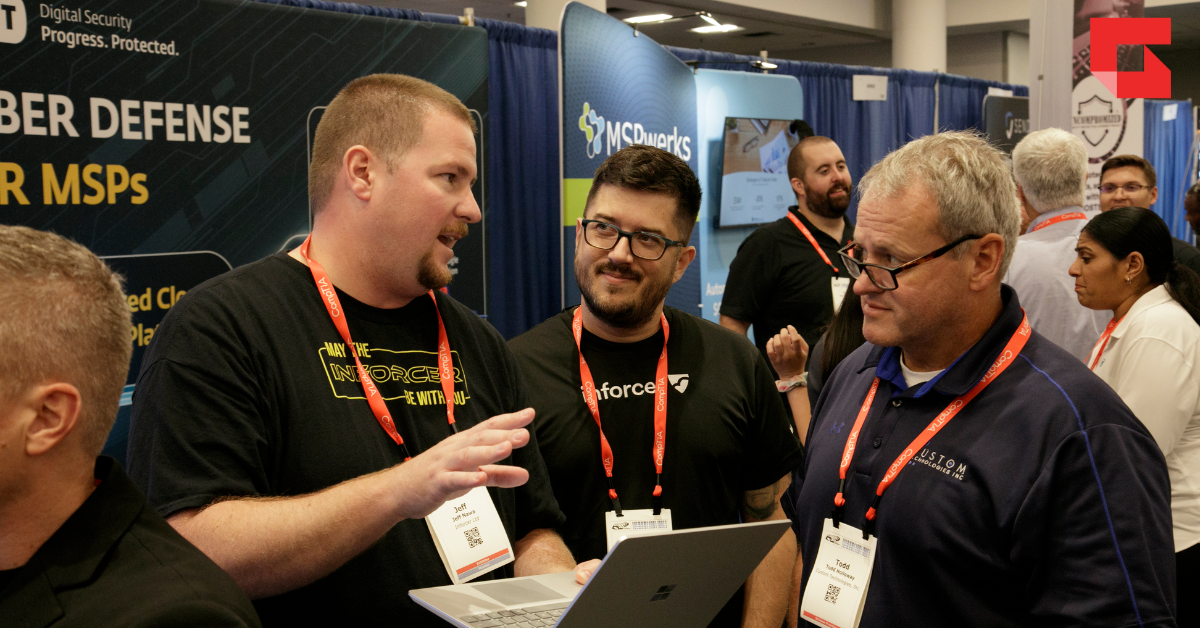
AI is everywhere in the ITSP world, but how much of it is actually changing how you operate? A panel of AI experts at the GTIA North America Community & Councils Forum revealed that the answer is complicated.
Far from the hype cycles that often shape industry conversation, this session, featuring moderator Jennifer Roy, CEO, Nucleus alongside Hank Dallam, CEO, NetGain Technologies; Callen Sapien, CEO/CTO, Synthreo and Hexi Xiao, CEO, Bumblebee, shared real stories from leaders who have been deep in the trenches of AI adoption. The group shared successes and failures that are all too relatable with ITSPs and MSPs navigating the AI landscape.
AI Isn’t the Fix. It’s the Flashlight
Roy teed up the conversation by asking what problems MSPs are trying to solve with AI that they aren’t yet ready for. The answer is that many MSPS are trying to solve everything with AI.
“We want to fix everything end-to-end,” said Sapien. “But we don’t even have the problem defined. A lot of these workflows have been automated over and over, but the underlying issue hasn’t changed.”
Xiao added that the challenge is less about ambition and more about understanding. “Before AI, people knew exactly where their pain points were and how to solve them,” he said. But now AI mimics human intelligence. We suddenly find ourselves experimenting in areas we’ve never touched before.
And Dallam cautioned MSPs against assuming AI will clean up operational debt. “Everyone wants something that will magically solve the service desk. But you have to be a fundamentalist first. AI hyper-scales bad processes,” he said.
Dallum suggests starting deliberately small. “We use AI internally on the unsexy stuff—meeting prep, meeting recaps—the things that take up a lot of smart people’s time.” It may not be glamorous, but it saves hours.
Many ITSPs Aren’t Ready Yet
As the conversation turned to structural readiness, Xiao was direct. “Our foundational stack isn’t built for AI. It’s a plumbing issue,” he said. And when the plumbing is bad, the experience is bad.
Even when the ROI is obvious, he added, many MSPs simply lack the operational scaffolding to deploy AI in high‑data or high‑risk workflows. Sapien, too, acknowledged constraints. “I could automate invoicing tomorrow. Technically, it’s easy. But I don’t do it,” he said. Why? The stakes are too high. And Dallam agreed, saying that customer-facing work is where his company is the most cautious. Trust takes years to build—and seconds to lose.
Where AI Is Delivering Value Today
Despite these guardrails, all three panelists highlighted areas where AI is making meaningful impact across MSP operations, starting with the obvious, the service desk. Sapien added he is also seeing AI show up in lead scoring and day-to-day workflows.
“Somewhere along the way, people got the idea that using AI is cheating, he said. “It’s not cheating. It’s just software. We have to break out of this idea that using AI is cheating.”
Xiao added that low-risk, repetitive tasks continue to be early wins. “Password resets, renewal reminders, audit prep—these are well‑defined. AI is incredible at finding mismatches and doing heavy lifting humans shouldn’t spend time on.”
But the standout operational transformation came from Dallam.“Ticket triage used to take 12 minutes. Now it takes 12 seconds,” he said. After a phased rollout, NetGain saw T1 and T2 unresolved tickets drop by half, and escalations fall 15%. “We’re not reducing headcount,” he said. “But we can scale a lot faster. And our team gets to work on higher-level problems.”
AI Isn’t Eliminating MSP Roles. It’s Evolving Them
When asked about workforce impact, Xiao offered a reframing: “We’re not seeing roles disappear—they’re evolving,” he said. For example, a tech who used to close tickets becomes an automation engineer, or a support agent becomes a business consultant. With the right AI in place, your people can spend more time on strategic conversations, not firefighting.
“We’re almost four years into the AI era,” Sapien said. “MSPs that don’t adapt might not exist. But the human in the loop isn’t going anywhere. The guide role is still essential.”
Hard Lessons: When AI Goes Wrong
The panelists were refreshingly honest about failures. Sapien admitted he once tried to rebuild a sales discovery engine with AI. In the end he shared that what he built cost more and wasn’t any better than the tools already out there. The lesson? Don’t get too excited and forget about what already exists.
Dallam recounted a failed attempt to automate invoicing. “We got angry calls and had to roll it back,” he said. And Xiao described challenges automating security incident response. “The stakes are extremely high and AI makes some mistakes. Right now, the risk is too great,” he said.
But as business owners and operators, you understand the value of failure. That holds true when it comes to AI. “Failing with AI is tuition,” Dallam said. We’re all learning together.
When MSPs Aren’t Ready. And When Vendors Aren’t Either
Roy asked whether the panel had ever declined business related to an AI request. All of them had a story. “Yes,” Dallam answered. “If a client doesn’t have governance or an AI champion in place, they’re not the right partner.”
Xiao looks for readiness on two fronts. “If a client isn’t prepared to learn—really learn—they’re not ready. Prompting is a new language. And sometimes we aren’t ready. If we don’t have the security architecture in place, we say no,” he said.
Sapien added, “Most of the time, when I push people away, they come back. I have to know what I can deliver. Taking money and time when I can’t deliver violates my core mission.”
The Path Forward: Start Small, Start Now
As the session closed, Roy asked the panel for one piece of advice MSP leaders should take home. Their responses may sound simple.
“Start trying,” Xiao said. “Pick a non‑critical use case in a controlled environment. Just start.” Dallam suggested ITSPs take 30 days. “Pick one workflow that’s dumb for your business and drains time. Judge it against one KPI. Starting is the hardest part.”
And Sapien encouraged ITSPs to not be hindered by the data piece. “Your data doesn’t matter,” he said. “Your processes do.” In other words, bad data isn’t what holds you back. Bad workflows do.
A New Chapter for MSP Operations
What made this discussion stand out wasn’t predictions or platitudes. Instead, it was the grounded reality that AI is operational leverage, not magic. It won’t fix broken processes, but it will expose them. It won’t replace people, but it will reshape their roles. And it won’t reward perfection—it will reward experimentation. The ITSPs who win in the next era won’t be the ones with the most AI tools. The winners will be the ITSPs who learn fastest.
GTIA members: Check out a library of AI readiness resources on the Member Portal.
Not a member yet? Join now!