Quick answer: At ChannelCon 2026, six channel executives from Ingram Micro, Microsoft, Thrive, ConnectWise, Nucleus Networks and Evergreen joined GTIA's Carolyn April to discuss where the IT channel stands today. The panel's consensus: AI has moved past the hype cycle and into measurable ROI, trust and data security are now the deciding factors in client relationships, and the channel's biggest opportunity is using AI internally before selling it externally.
Channel Leaders Agree: AI Has Moved Past the Hype Cycle
The Channel Visionaries Power Panel opened with a direct question from Carolyn April, vice president, research at GTIA: What will separate successful channel companies today?
The panelists agreed on one thing immediately—the AI debate is over. Manny Rivelo, CEO of ConnectWise, pointed to hard numbers: Companies investing in AI tools over the past 12 months are seeing measurable returns, with best-in-class organizations posting 14% gains. "It's not hype anymore," he said. "It's real, and it's impacting how you run your business." The remaining question, he added, is whether to build or buy.
Craig Fulton, M&A advisor at Evergreen, framed the shift in terms of customer service. Channel companies have spent years automating their own operations. The next move is helping customers do the same—starting with better understanding of customer needs across verticals, not a full-scale rollout on day one.
Nina Harding, corporate vice president at Microsoft, added a caution alongside the optimism. The channel has moved from experimenting with AI to depending on it operationally. But trust remains the deciding factor. Clients need confidence that the platform behind an AI solution is secure, because when something goes wrong, they're calling their MSP first. Security and data, she said, is the foundation everything else sits on.
Jennifer Anaya, SVP of global marketing at Ingram Micro, reframed AI as less of a technology conversation and more of a business opportunity. Partnering and understanding real client needs may matter more than the tools themselves—and AI's biggest value is in reducing the friction that has always made channel business complex.
The panel's biggest opportunity call came from Jennifer Roy, CEO of Nucleus Networks: Internal adoption first. Many MSP operators still aren't using AI inside their own businesses. Her advice—use the tools before asking clients to trust you with them, and lead client conversations with business outcomes rather than technology specs.
Build vs. Buy: A Question of Core vs. Context
Asked how MSPs should decide between building AI tools in-house or buying off the shelf, Rivelo offered a clear framework: Separate what's core to your business from what's context. Core capabilities—the things that differentiate a company in the market—are worth building. Context—the operational tools needed to run the business—are usually better bought. The risk, he noted, is mistaking something disruptive for something core.
Jonathan Philipsen, EVP of channel & alliances at Thrive, echoed the same lens: Some tasks are better purchased off the shelf to stay agile, while other capabilities become the foundation of what a company sells to its own clients.
Anaya returned to data as the connective tissue across the conversation. Channel companies already sit on top of client networks, data and security—understanding how to use that position well will define competitive advantage over the next several years. Harding agreed, noting that change management conversations increasingly lead straight to data and security, and that tying those conversations to the metrics clients care about is where the real value shows up.
Cybersecurity: Standardize First, Then Scale
On what smaller ITSPs can do to stay secure, Roy pointed to fundamentals: A standard, compliant technology stack. Without that foundation, she said, everything built on top of it becomes unstable. She also pointed to peer communities like GTIA as a practical resource for benchmarking against others facing the same challenges.
Philipsen described this as operational discipline—"slow down to speed up"—both as a security practice and as proof to clients that a company holds itself to the same standard it recommends. Harding noted a shift in the nature of the threat itself: Security concerns used to focus on outside threats but now include identifying the growing number of AI agents operating inside a company's own environment.
Roy closed the topic with a workforce reality check: Executing on strong security practices requires trained talent, and that talent is in short supply. Investing in people, she said, isn't optional.
M&A: Recurring Revenue Is Still the Prize
Private equity has reshaped the channel, and the panel didn't shy away from what buyers are looking for. Fulton pointed to recurring, contracted revenue as the primary driver behind the wave of MSP acquisitions—the same model that first drew PE into SaaS. Companies looking to maximize valuation should focus there first.
Rivelo added a new variable to the equation: AI's ability to change a company's profitability model is itself becoming a factor that attracts PE interest. Philipsen rounded out the buyer's checklist with three criteria: Contract revenue, culture and how effectively a company is using AI to operationalize its business—plus a practical reminder to get documentation in order well before a deal conversation starts.
Culture and trust remain central once a deal happens. Fulton emphasized that a successful ITSP is built on relationships specific to their community—not a playbook that transfers cleanly from one market to another. Knowing an acquirer's plans in advance, and protecting the customer relationships already built on trust, matters as much as the deal terms themselves.
AI and the Workforce: Adding Value, Not Replacing People
The panel's final topic tackled the human side of AI adoption directly. Anaya named culture as the deciding factor in whether employees trust what leadership is doing with AI. Harding shared that her own sales organization has shifted toward people who know the industry deeply rather than pure technologists—and that some of the most innovative ideas inside her company are coming from non-technical staff who are being freed up for more strategic work.
Philipsen added that curiosity, not technical background, tends to produce the best ideas—and that framing AI adoption around adding value, rather than reducing headcount, is essential to getting that curiosity out of people. Roy agreed: Leading with why, staying transparent about intent and following through on that intent builds the trust that makes adoption possible.
Rivelo pointed out that technical skill isn't going away—it's evolving. The bigger opportunity sits with the people running the business, who can ask a simple but powerful question: If we built this from scratch today, how would we do it more efficiently? Harding added that she's investing more, not less, in technical talent, particularly around data and security, as end users gain more ability to build tools themselves.
April closed the panel with a broader observation: AI may be the first force with the potential to break down long-standing silos between departments—and even bring the industry closer together.
Best Leadership Advice from the Panel
- Jennifer Anaya: Listen hard.
- Craig Fulton: People are what make companies great.
- Nina Harding: Stay curious and keep a growth mindset—ask "why" on repeat.
- Jonathan Philipsen: This is an evolution, not a revolution.
- Manny Rivelo: Lead with clarity. Act with urgency. Change your culture faster than the environment changes around you.
- Jennifer Roy: Take risks.
Frequently Asked Questions
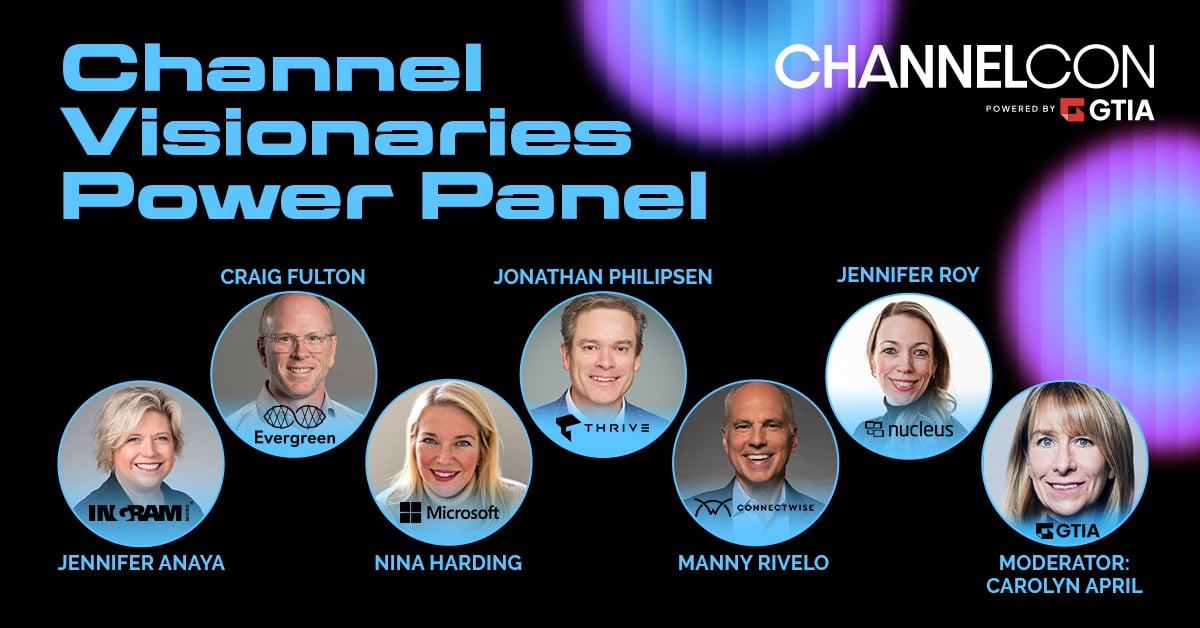
Who spoke at the Channel Visionaries Power Panel at ChannelCon? The panel featured Carolyn April (GTIA, moderator), Jennifer Anaya (Ingram Micro), Craig Fulton (Evergreen), Nina Harding (Microsoft), Jonathan Philipsen (Thrive), Manny Rivelo (ConnectWise) and Jennifer Roy (Nucleus Networks).
What did the panel say about AI adoption in the channel? The panelists agreed AI has moved past the hype cycle into measurable business impact, with best-in-class companies seeing double-digit returns on AI investment. The bigger opportunity, they said, is internal adoption—using AI to run the MSP's own business before selling AI-enabled services to clients.
How should MSPs decide whether to build or buy AI tools? Panelists recommended building AI capabilities that are core to what differentiates the business and buying tools for operational tasks that support the business but aren't a source of competitive advantage.
What's driving M&A activity in the IT channel right now? Recurring, contracted revenue remains the top driver of channel acquisitions, with private equity buyers also weighing culture, AI-driven profitability, and documentation quality.
Will AI replace jobs in the channel? The panel's consensus was no. Leaders described AI as a way to reduce mundane tasks and free up staff for more strategic, creative work—while noting that technical talent, particularly around data and security, remains in high demand.
Get more ChannelCon news and follow GTIA on LinkedIn!