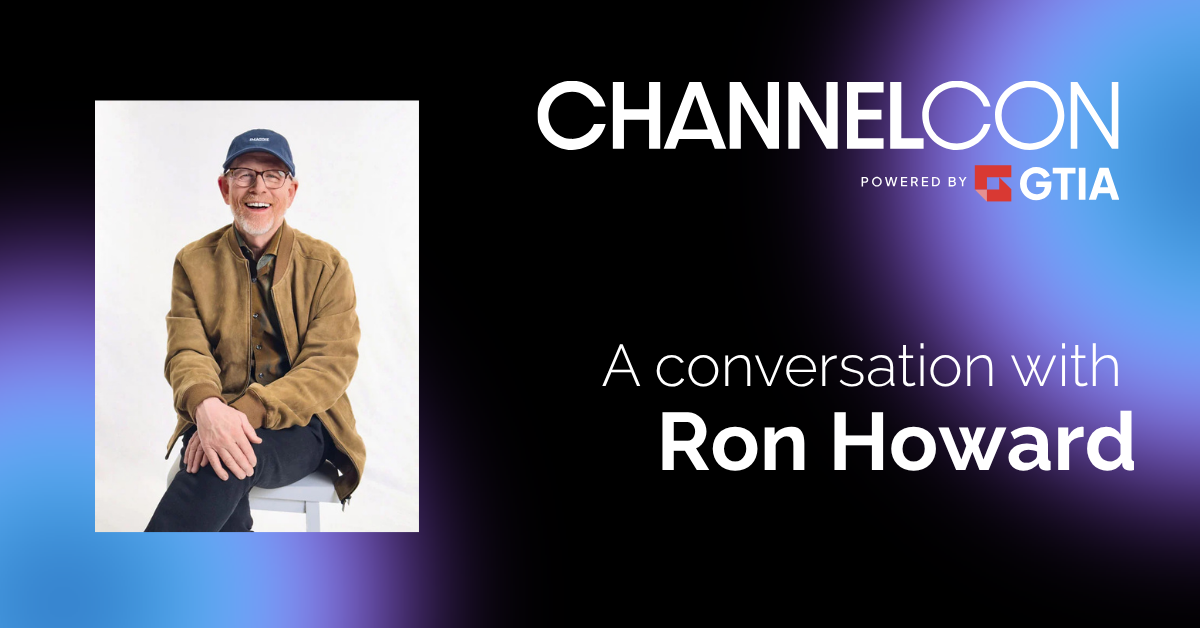
Quick Answer: Academy Award-winning director Ron Howard joined Tracy Pound, managing director at Maximity Ltd, for a conversation on leadership and storytelling. Howard connected six decades of filmmaking to the challenges IT channel leaders face today: Leading through technology shifts, building trust across teams and treating every project like a startup. His core message: Prepare rigorously, address conflict early and give people ownership in the outcome.
Ron Howard has directed blockbusters, led a production company and worked through six decades of technology and audience shifts. At ChannelCon 2026, he sat down with Tracy Pound, managing director at Maximity Ltd, for a chat that connected the craft of filmmaking directly to the work of leading in the IT channel.
Howard didn't offer a highlight reel of Hollywood stories. He gave channel leaders a working playbook for leading teams through disruption, and it holds up well against what MSPs, solution providers and vendors are navigating right now with AI and rapid technology change.
Here are the themes that stood out.
Treat Every Project Like a Startup
Howard made the shift from acting to directing because he wanted more ownership over outcomes. "Each and every project is like a startup," he told Pound. That framing—a defined mission, a small window to prove it, real stakes—maps directly to how channel businesses operate. Every client engagement, every new service line, carries the same startup logic: Build the case, commit fully and be honest when the case isn't there.
Build Trust Through a Shared Narrative
Filmmaking requires dozens of specialists to move in the same direction. Howard's approach is to set the framework, then invite every contributor to shape what the project becomes. "I treat every department like they are filmmaking collaborators," he said. "It's a bit chaotic, but inclusive."
The lesson for channel leaders: Give teams a clear framework and genuine input, not just instructions. When people understand the shared goal, Howard noted, the quality of their feedback goes up.
Go Into the Friction Early
Asked about the hardest leadership lesson he's learned, Howard didn't hesitate: Address conflict immediately. "Don't let things simmer, don't let problems get bigger," he said. He's applied that with actors, directors and studio executives alike. For channel leaders managing client escalations, vendor disputes or internal team friction, the advice translates directly—the earlier you engage, the smaller the problem stays.
Structure Creates Room for Collaboration
Howard grew up on set as a child actor and learned that structure and creativity aren't opposites. Actors could pitch ideas, and the best idea won, but when it was time to shoot, everyone understood the standard. "It was fun and there was a lot of laughter," he said of his time on The Andy Griffith Show, "but when it was showtime it was on." IT channel leaders balancing flexible, collaborative cultures with delivery deadlines will recognize this immediately.
Facts Support the Narrative But Aspiration Drives It
Pound asked Howard how storytelling differs from simply communicating a message. His answer centered on aspiration: Every story needs a goal, a barrier and a choice. Facts support that arc, but they don't replace it. Channel leaders pitching a service, a partnership or a change initiative can apply the same structure—lead with what the audience wants to achieve, then bring the facts in to support that case.
Failure Is Part of the Long Game
Howard credited a piece of advice from writer, director, producer and actor Garry Marshall: Not every television episode will be the best and setting that as the standard sets you up to fail. Howard's approach is to fight hard for every project while it's in motion, then accept the outcome and keep building. For channel businesses experimenting with new AI-driven services or unfamiliar go-to-market models, that mindset—minimize the failures you can control and expect that not everything will land—is a useful guardrail against overcorrection.
New Tools, Same Human Factors
Pound raised the parallel between Hollywood's technology shifts and the AI disruption facing the channel today. Howard's take was optimistic: New tools expand what's possible and give more people a way to find an audience. But he was clear that the human component—understanding your team, building trust, staying prepared—doesn't get replaced by the tools. It becomes more important.
The Takeaway for Channel Leaders
Howard's advice throughout the session kept returning to one idea: Rigorous preparation creates the space for problem-solving, not the other way around. Leaders who are over-prepared can afford to shift when something unexpected comes up. Leaders who are under-prepared and rigid cannot. For an industry moving through its own significant technology shift, that's a useful reminder.
Frequently Asked Questions
Who is Ron Howard? Ron Howard is an Academy Award-winning filmmaker, director, and producer with a career spanning more than 60 years, including films like Apollo 13 and A Beautiful Mind.
Who interviewed Ron Howard at ChannelCon? Tracy Pound, managing director of Maximity Ltd, led the conversation.
What was the main topic of the keynote? Leadership, storytelling and how to lead teams through periods of major technology and industry change.
What did Ron Howard say about handling conflict? He advised leaders to "go into the friction" early rather than letting problems build, a lesson he's applied throughout his career with actors, directors and studio executives.
What did Ron Howard say about new technology? He described new tools as democratizing, giving more people the ability to create and find an audience, while emphasizing that understanding your team and the human side of leadership matters more, not less, as these tools evolve.
Get more ChannelCon news and follow GTIA on LinkedIn!