Quick Answer: AI has made technical answers available in seconds, so an MSP's value now comes from judgment, not information. At ChannelCon 2026, FieldGuide IT co-founder Nicole McCall explained that MSPs succeed by applying what AI cannot: A client's systems, history and risk tolerance. The role shifts from encyclopedia to judge.
AI is making technical answers easier to find, but Nicole McCall, co-founder and chief experience officer at FIeldGuide IT, argues that this does not make the people delivering IT services less important. Instead, it changes what clients need them to do.
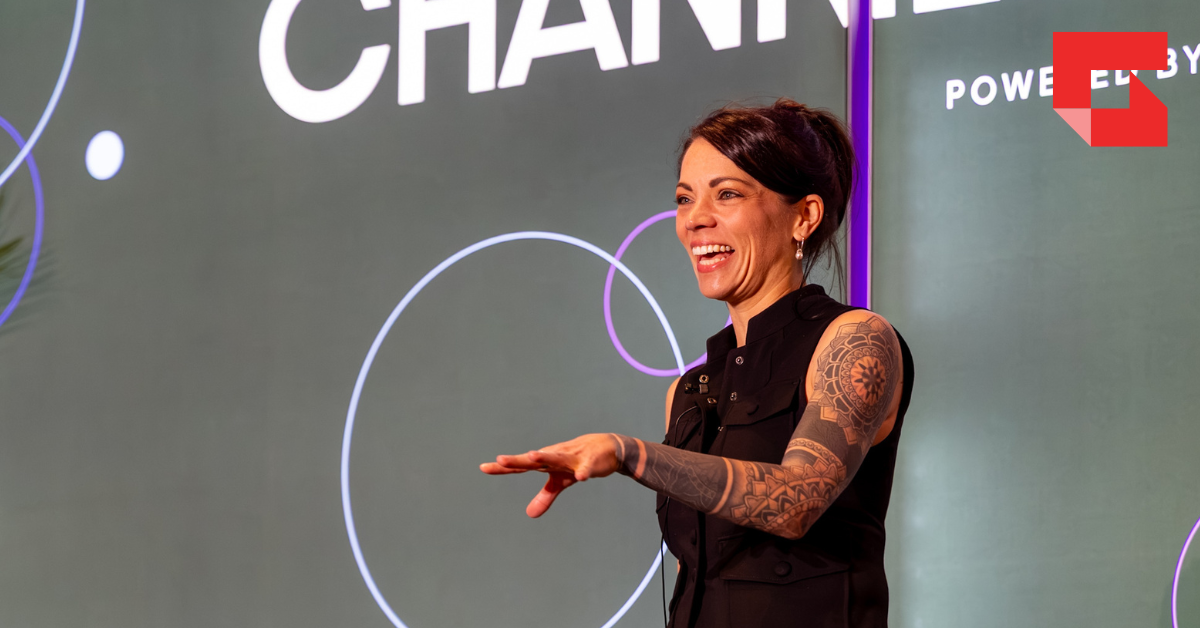
McCall made that case during “Building Iron Man Suits,” a solo presentation at ChannelCon 2026 in San Diego. FieldGuide IT had spent roughly two years weaving AI, automation and system integrations into its operations, with the goal of eliminating work that distracted employees from serving clients.
But McCall’s most consequential point was not about automation, it was about what happens to expertise when nearly anyone can generate a plausible answer in seconds. “If anybody can get a plausible answer in nine seconds—your client, your client’s intern, your client’s board member—the value isn’t really much in the answer anymore,” she said.
The MSP still knows things AI does not: The client’s technology stack, history, risk tolerance and what has been tried before. That context increasingly separates obtaining an answer from knowing whether to trust and apply it.
“The old job was knowing the answer and the new job is judging the answer. AI is not demoting us. It’s promoting us into a new role. It’s moving IT from encyclopedia to judge. Encyclopedia is our commodity now, but judges aren’t,” McCall said.
Automate the Work Around the Decision
FieldGuide IT’s approach started with finding the work that consumed employees’ attention without necessarily requiring their expertise. McCall jokingly called one measure the “ClickJitsu test”: How many clicks did an employee have to make to complete a task?
A suspicious email provided one example. An engineer might have to move among multiple systems to investigate the domain, determine whether it was legitimate, block it if necessary and complete follow-up work. If FieldGuide IT received enough of those requests, automating some of the surrounding research and workflow could return meaningful time to its engineers.
The same principle extended across the company. FieldGuide IT worked to automatically surface previous tickets and device information for support engineers, track shipments and other onboarding details for its “crossboarding” team, gather compliance evidence and pull customer communications and ticket trends together for employees managing client relationships. The goal was not to automate the judgment at the end of those processes. It was to make sure employees reached that decision with the relevant information already in front of them.
Volume mattered, too. McCall said FieldGuide IT looked at how frequently an automation would run and how much employee time it could save. A process occurring once a week might remain low on the list if automating it required significant resources.
The Human Stayed Between AI and the Customer
FieldGuide IT also established boundaries around what its increasingly automated operation could do. The company created an AI acceptable-use policy and a software development lifecycle policy. Employees could experiment, but production data required security review. AI-generated work remained subject to human review, particularly when it would reach a customer.
“If it’s going to touch the customer—the customer’s going to see it—there’s got to be a human before that happens, at least in the phase we’re in right now,” McCall said.
Another rule was more revealing: If FieldGuide IT turned off its AI systems the next day, McCall said the business would still run. It might operate less efficiently, but AI remained a tool rather than a dependency.
How to Set AI Guardrails Before You Scale
- Keep humans at the judgment layer. Automation gathers information and handles repetitive work; people remain responsible for decisions.
- Put humans before customer-facing output. AI-generated work receives review before reaching clients.
- Make AI optional. Your business processes have to be able to function without it.
- Let employees experiment within boundaries. Production data requires security review before new tools or automations ship.
- Prioritize repetitive work. Frequency and potential time savings help determine which processes are worth automating.
- Give customers an exit. If clients interact with automation, McCall argues they should always have a route to a person.
AI Makes MSPs’ Differentiators More Important
McCall ultimately asked MSPs to identify their “superpower” before deciding what to automate. For one provider, that might be unusually deep knowledge of manufacturing environments. For another, it could be industry expertise or simply answering the phone every time a client calls.
That distinction matters because McCall is not arguing that AI itself creates differentiation. If the technology makes information and first drafts broadly available, competitors and customers gain access to many of the same capabilities.
What remains harder to reproduce is judgment informed by a particular client, relationship and history. The technology can put more information in front of an MSP employee and remove some of the clicks required to get to a conclusion. But McCall’s argument ultimately rests on what happens next. The answer is increasingly cheap. Knowing what to do with it isn’t.
GTIA members, check out our library of business-building AI resources on the Member Portal.
Not a member yet? Join now!