Historically, SMB-sized customers have comprised the sweet spot of the typical channel firm’s customer base. And though smaller in size, over the years these customers have exhibited a healthy appetite for technology as a strategic asset to their business. Does that hold true for 2025?
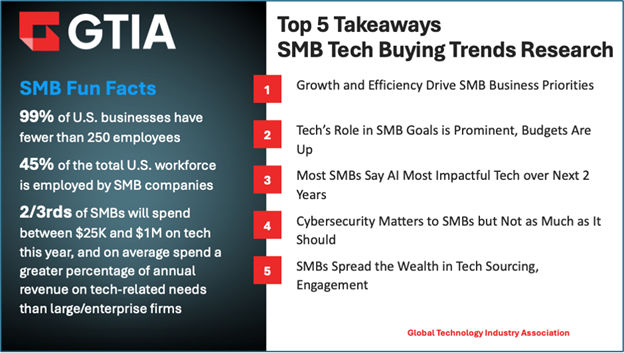
New GTIA research reveals that’s still the case. Findings from the GTIA SMB Technology and Buying Trends 2025 report, released at ChannelCon 2025, show that nearly two-thirds of SMBs are set to spend between $25K and $1M on tech this year, with many investing a higher share of revenue on technology than large enterprises.
“Today’s SMBs are prioritizing growth, operational efficiency and increasingly AI,” said Carolyn April, vice president of research and market intelligence, GTIA. “And with 80% of SMBs acknowledging they have "some or a lot of room” for improvement with respect to vision and strategy for use of tech, the time is now for IT service professionals (ITSPs) to step in and get IT done right.”
Here are five key takeaways from the report.
Growth and Efficiency Drive SMB Priorities
When it comes to SMB business priorities, growth, efficiency and talent acquisition top the charts. SMBs across a wide range of verticals—not just the IT channel—are putting their eggs in these baskets:
- - Acquiring new customers and/or expanding into a new market (43%)
- - Implementing more efficient systems (41%)
- - Hiring skilled workers for strategic goals (39%)
“There are opportunities for all of you in these areas,” April said, noting that ITSPs should be having conversations with their customers about business needs, revenue opportunities and pain points. “Those are the discussions that will win you more customers,” she said.
The study also shows that SMBs need ITSP help when it comes to putting their technology vision and strategy into practice. In fact, just 32% of SMBs believe they are excelling with their ongoing technology operations, with 25% believing to excel with their execution and implementation. However, just 19% of SMBs say they excel when it comes to vision and strategy.
April says this is another opportunity for solution providers to step in.
“It takes you out of the realm of being the nuts and bolts tech provider. You can get involved in sitting down with them and talking strategy to help them get there,” she said.
Tech’s Role in SMB Goals is Prominent, Budgets Are Up
Just how important is technology to SMB’s goals? Four in ten SMBs have increased their spending year over year from 2024 to 2025. April says this means we aren’t stagnant and instead moving in the right direction.
The sweet spot in annual spending looks to be about $50K - $250K, depending on the size of the business. “You can estimate that those who are spending the most are the companies that have well over 100 employees and typically have an IT department,” April said.
But what SMBs say their tech needs are don’t always align with their spending. For example, SMBs say that these are their top tech improvement needs:
- - Hiring workers with newer tech skills (AI, cybersecurity, etc.)
- - Cybersecurity/data security
- - Effectively managing/using data
- - Integrating apps, devices, etc.
- - Getting more ROI from tech spend
- - Managing increasingly complex tech
But the majority of their actual spending goes toward maintaining stable operations. April says this isn’t necessarily surprising as most SMBs have wish list ideas that they never really get around to implementing.
“They’re putting most of their resources into making payroll, paying rent and making sure they’re doing everything they need to succeed as a business,” she said.
But, if they had a tech wish list, what would be on it?
The largest group of respondents (35%) said they would invest in more innovation and cutting-edge technology, yet another opportunity for ITSPs to step in and provide expertise.
AI Is Most Impactful Technology Over the Next Two Years
The basic attitude about emerging technology in general is positive. But when asked what emerging tech will have the most impact in the next two years, 63% say it’s AI. That’s a clear winner.
April offers one caveat, saying that the study didn’t differentiate “impactful” as positive or negative. “There may be some that know AI is going to have a big impact on how we operate,” she said. “And they may not think that’s a good thing.”
While that may be true, interest in AI adoption is increasing, with 31% of SMBs saying they are ambitious, meaning they are in production, using AI within their business in some way, shape or form. The majority, 48%, say they are in the planning phase—piloting AI projects and playing around with the technology. And 20% say they aren’t involved yet or have no plans to use AI.
April expects those numbers to shift somewhat next year, predicting that there will be more SMBs in the “ambitious” phase than the “planning” phase.
What’s keeping SMBs from adopting AI:
- - Cost of entry (38%)
- - Lack of tech training (37%)
- - Identifying suppliers (30%)
- - Hiring skilled staff (28%)
- - Lack of quality data (28%)
- - Unknown ROI (24%)
“There is a lot of room to grow and a lot of room to talk to your customers about AI,” she said. “This is an opportunity to be a strategic advisor.”
Cybersecurity Matters to SMBs, But Not as Much as It Should
SMBs are far more vulnerable to catastrophic results from a cyberattack than larger corporations. A good-enough mentality toward cybersecurity is far too risky in today’s fraught landscape. SMB respondents in this study have not yet figured that out fully.
While most do have cybersecurity on their radar, the study reveals that their focus is not to the degree it should be. Just 28% of SMBs identified cybersecurity as an area they worry about negatively impacting their business this year, which flies in the face of statistics that identify the demographic as an especially vulnerable target.
When asked how they would rate the attention and spending focus that cybersecurity attracts at their organization, 40% described it as strategic and proactive. It means cybersecurity is top-of mind for their company owner and other stakeholders and that a healthy percentage of total tech budget is devoted to cybersecurity spending. Sounds great right? Not so much. Four in 10 SMBs having a strategic and proactive approach is far lower than it should be. The potentially grave risks of cyberattacks should be lighting a fire under most or all SMBs to adopt this mindset.
April says ITSPs have an opportunity to step in as an educator to help SMBs understand how important cybersecurity is to their business.
SMBs Spread the Wealth in Tech Sourcing, Engagement
Sourcing is diverse among SMBs, including purchasing direct from vendors, online marketplaces, retailers and the channel. The clearly dominant sourcing choice for SMBs is directly from vendors, which 65% of respondents selected from the list of tech procurement options.
Forty-five percent say they source from online marketplaces, 40% from retailers and 28% from the channel. To clarify, SMBs could choose multiple supplier options for this survey question and the purchase types they were asked to consider were defined as transactions made for hardware devices, network infrastructure and equipment, and software (including subscriptions)—but not for managed services contracts/recurring revenue, consulting, projects or other services-related transactions.
April says SMBs are looking to ITSPs for the higher margin, more lucrative engagements, and this clear delineator illustrates that we have moved into a services era in the channel.
And more good news—SMBs are seeking out IT services. Specifically, 61% report outsourcing IT services either regularly or occasionally, confirming that SMBs are indeed a sweet spot for ITSPs.
“SMBs and the channel partners who support them are stepping into a new era of technology leadership and B2B growth,” said April. "The future is now as SMBs and ITSPs forge stronger partnerships and work together to enhance security, scale efficiently and apply AI in meaningful ways to improve upon the customer experience, productivity and innovation, while operating secure by default."