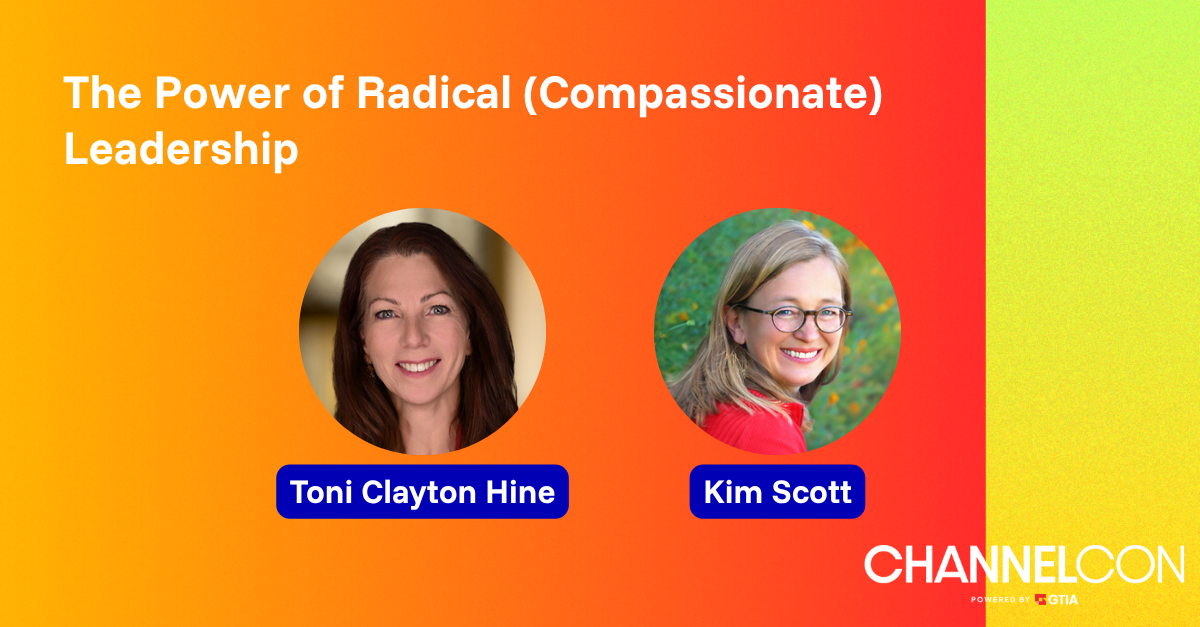
Artificial intelligence has taken center stage at ChannelCon 2025—and for good reason. But amid the buzz about machine learning and automation, one essential element deserves more attention: Human emotional intelligence. As we evolve with technology we cannot overlook the power of empathy, connection and self-awareness. That’s exactly what Kim Scott, author of Radical Candor: How to Be a Kick-Ass Boss Without Losing Your Humanity, told ChannelCon attendees.
The premise of radical candor boils down to having the ability to care personally and challenge directly.
“Relationships don’t scale, but culture does,” Scott said. “When you choose to treat the people around you with that kind of care, it’s more likely they will treat the people around them with that kind of care.”
And while that sentiment hardly seems radical, it is indeed rare. Why?
Scott told the audience that most of us have been told by someone early on in our careers to “be professional.” But leaving your emotions at the door isn’t the answer. “You want to be more than just professional. You have to build real human relationships at work,” she said. That’s where caring personally comes in.
On the flip side, Scott asked the audience how many people were told as a child, “if you don’t have anything nice to say, don’t say anything at all.” Unsurprisingly, most of the room raised their hands. But if you can’t challenge people directly, you’re not doing them any favors either.
Scott told a story of an employee she once managed who was a great person with creative instincts that everybody on the team liked. But his work was consistently sloppy. Instead of confronting the issue head on, right away, she made the mistake of letting it go for nearly a year. When she finally made the hard decision to let him go, he was upset.
“He said, ‘why didn’t anyone tell me? I thought you all cared about me.’ By not telling him, I thought I was being nice. But here I was firing him and that wasn’t nice at all,” Scott said. “I made myself a solemn promise that I would not make that mistake again and help other people avoid making that mistake as well.”
Related Content: Does Your Organization Champion Candor?
Practical Things You Can Do to Avoid Making That Mistake
To start carrying out the “care personally” and “challenge directly” mantra, take these steps: Solicit feedback, give praise and understand how your feedback landed for the other person.
Get It: Solicit Feedback
Everything starts with asking for feedback. Scott recommends regularly building this into your 1:1 meetings. Here are some tips:
- Create your “go-to” question. Don’t ask your manager if they have feedback for you. Come up with a question that authentically sound like you and can’t be answered with a simple “yes” or “no.”
- Embrace the discomfort. After you ask that question, close your mouth. Scott suggests counting to six, because almost no one can endure a full six seconds of silence.
- Listen with the intent to understand, not respond. It’s ok to ask a follow-up question because it’s common to misinterpret the criticism we receive.
- Reward the candor. A simple thank you will suffice, but if you respectfully disagree with the feedback, it shows you care enough about the person’s opinion to share what you think. And just maybe, you change your mind.
Give It: Give Praise
Scott is a big fan of what she calls the two-minute impromptu talk. “It’s like brushing and flossing,” she said. If you consistently brush and floss, you avoid the root canal. These two-minute talks can take place after a meeting. “I’ll text them and say, ‘hey I noticed something, and I want to tell you about it before I forget,’ or ‘I know you care a lot about this project and I noticed something that will help you make it more successful,’” she said. Here are some tips:
- Have a humble mindset. Scott says she calls it candor, not truth, because she doesn’t have a pipeline to God.
- State your intention to be helpful. Starting the conversation with good intentions can open the door.
- Don’t delay. Have these short talks immediately for the best impact.
- Have a conversation. In person conversations are best, but if you can’t do that, at least pick up the phone versus an email, or a message.
- Criticize in private and praise in public. Use the C.O.R.E feedback model:
C – Context: Cite the specific situation where the behavior occurred.
O – Observation: Describe what was said or done.
R – Result: Explain the most meaningful consequence to you and them.
E – Expected Next Steps: Outline the expected next steps.
Scott encourages managers to say more than “great job,” by being specific and sincere. “If it’s something you would say to your dog, it’s not great praise,” she said.
Gauge It: Understand How it Landed
Feedback is not measured by the speaker’s mouth, but by the listener’s ear. Scott encourages leaders to pay attention to how their feedback is received based on reactions and choose the right direction. Here are some tips:
- Sad Reaction: Be clear but take an extra beat to show how you care.
- Angry Reaction: Get curious, not furious. Ask yourself why this person is upset and how could I have said it differently?
- No Reaction: If they aren’t hearing you, keep challenging them directly, probably further than you’re comfortable with.
Applying Radical Candor to Your Organization’s Culture
Scott was joined by GTIA board member, Toni Clayton-Hine, chief marketing officer at EY Americas, to dive in a bit deeper and ask how to apply this framework to an organization’s culture.
Scott’s advice is that it all starts with leadership.
“Start with leaders and make sure leader are soliciting feedback,” she said. “Add an item to your staff meetings to ask what radical candor you are soliciting this week and what you did about it.”
Clayton-Hine liked the idea of the two-minute impromptu talk immediately after a meeting, but asked the question that everyone in the audience could relate to: What if you have another meeting right away?
Scott’s answer was that you must be willing to be late.
“Recognize that these two-minute impromptu conversations are an important part of doing better work and building better relationships. This isn’t an extracurricular activity, it’s part of your job,” she said.
Because the biggest failure is not having the conversation at all.