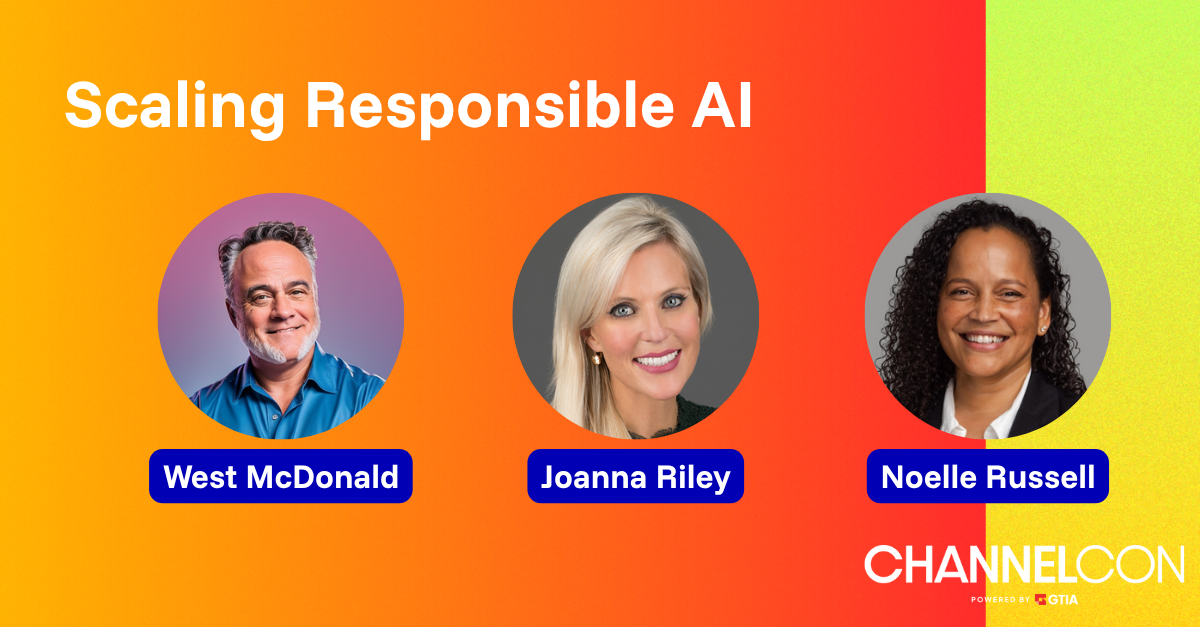
Did you know that baby tigers are born blind? Because their eyes are not fully developed at birth, they rely on their mother’s care for the first few weeks of their lives. Noelle Russell, AI expert at the AI Leadership Institute, likened AI models to baby tigers at ChannelCon 2025 and the analogy is spot on.
When your clients build AI models, they are in the “baby tiger” phase. It’s cool and it’s cute. “We don’t care if it’s right or wrong, or legal,” Russell said. “But we have to ask baby tiger questions. How big are you going to be? Where are you going to live? How sharp are your teeth? What happens when I don’t want you anymore?”
“Baby tigers become big tigers, and big tigers can kill people,” she said. “We have to be careful with this stuff.”
Tiger warning aside, Russell is a huge proponent of AI systems, telling the audience that her goal is to encourage everyone to get into the world of AI and see the massive opportunity that lies ahead of us.
“The technology will rapidly expand, three times its ability every three months,” she said. “But the burden is on us—the solution architects—to think bigger and innovate on behalf of our customers. Wherever your mindset is, you’re in a two-year period that is critical for your success.”
Related content: AI Needs Human Leadership: How Do You Start?
AI Success Begins with JEDIs and POETs
Russell shares she was once coined an “AI Jedi,” a title she happily accepts. But Jedi actually means more to her than a cool lightsaber. It stands for justice, equity, diversity and inclusion.
“Weaving this into the DNA of your applications and solutions is like water in a wave, not a raisin in a bun,” she said. She encourages ITSPs to think about those baby tiger questions along the way when building AI systems.
Joining Russell on stage, Joanna Riley, CEO and founder, Censia, asked how ITSPs can embed ethics and governance in a practical way.
“Never build without them,” Russell said. "Most executives have no idea how to translate what they want for their business to an engineer. I use words that mirror that words of my executives and build what they asked for.”
West McDonald, founder and chief AI strategist, GoWest.ai, recommends helping customers build AI policies and guidelines. “There are so many ways we can use AI that we don’t even know when we’re using it wrong,” he said. “Take the time, work with all of the departments within your organization, but still allow for curiosity.”
Russell agrees, adding that ITSPs can take what’s already working in other organizations and apply that to their own, citing enterprise architecture guides and implementation guides from the Department of Energy and the Department of State. “Build on top of the shoulders of people who have already spent that money,” she said.
Download >> Developing Usage Policies and Guidelines
The other side of responsible AI is how the model is actually working for you. Russell shares her “POET” approach:
- - Precision: Using data to create precise outcomes
- - Optimization: Asking how you can do things better
- - Ethical Foundation: Move fast with intention
- - Trust: Trust the technology and earn trust from your customers
“Everyone is starting with zero knowledge about AI, it was taught to them,” Russell said. “And with a passion to solve a problem, you can make it happen.”
McDonald shares that when people ask him what they need to get started with AI, he recommends starting simple.
“We do that by looking at workflows,” he said. “Don’t look for the AI solution, go backwards. Look at where you need help in your organization and then find a solution to solve that problem.”
Who’s Winning at AI Right Now?
So, who’s getting it right? The experts caution that AI isn’t a one-size-fits-all solution.
“We want the MSPs we work with to use AI with some kind of framework,” McDonald said. “We’ve seen things fall down when a promise has been made. There’s nothing wrong with the offerings, but it’s not always a solution for all.”
Instead, McDonald tells the audience to look at associated revenues and think more about how we can help companies build and support AI systems. “Everyone in this room has that power,” he said.
“The biggest shift I’ve seen happen is curiosity into confidence and the ability to learn by doing,” Russell said. “Those are the people that are winning right now.”
McDonald agrees, noting that people are afraid of being replaced by AI. “I’ve not seen that happen in my three years of experience,” he said. “What I have seen are companies that aren’t using AI being replaced by companies that are.”
Using AI to Support Smarter Decisions
Yes, AI can help you rewrite your emails. But it can do so much more. Trying to let AI do a job versus helping you optimize a job is a big failing according to Russell, who refers to AI as a judgement amplifier.
“Companies are going to need teams that are using AI systems to do the judgement work, but the humans hold the thresholds,” she said.
That human component is scaling within companies, and Russell says that AI forward is human first.
“Very few people are experts in AI,” Riley said. “It’s a moment to lean in and a moment to try new tools. Humans that know AI are going to replace humans that don’t know AI.”
Learn by Doing
Russell says the best way to get into AI is to learn by doing and start practicing. “Go into ChatGPT and tell it to build you something—and do it every day,” she said.
McDonald agrees, adding that ITSPs should be less skeptical and more curious about the opportunities AI brings.
“You have more power at your fingertips that ever before,” Russell said. “But with great power comes great responsibility.”