Quick Answer: The productivity trap is the plateau MSPs hit after their first growth phase, marked by unplanned work, constant reprioritization and decisions that keep escalating back to the founder. Growth and profitability are only weakly correlated, and firms that keep growing are the ones that change how they operate. Matthew Whitehouse, founder and business advisor at BTGCO, recommends three tools to move past it: The Founder Dependency Risk Model, five KPIs that track dependency and drag and the Founder Blackout Exercise, a thought experiment that maps what happens if the founder disappears tomorrow.
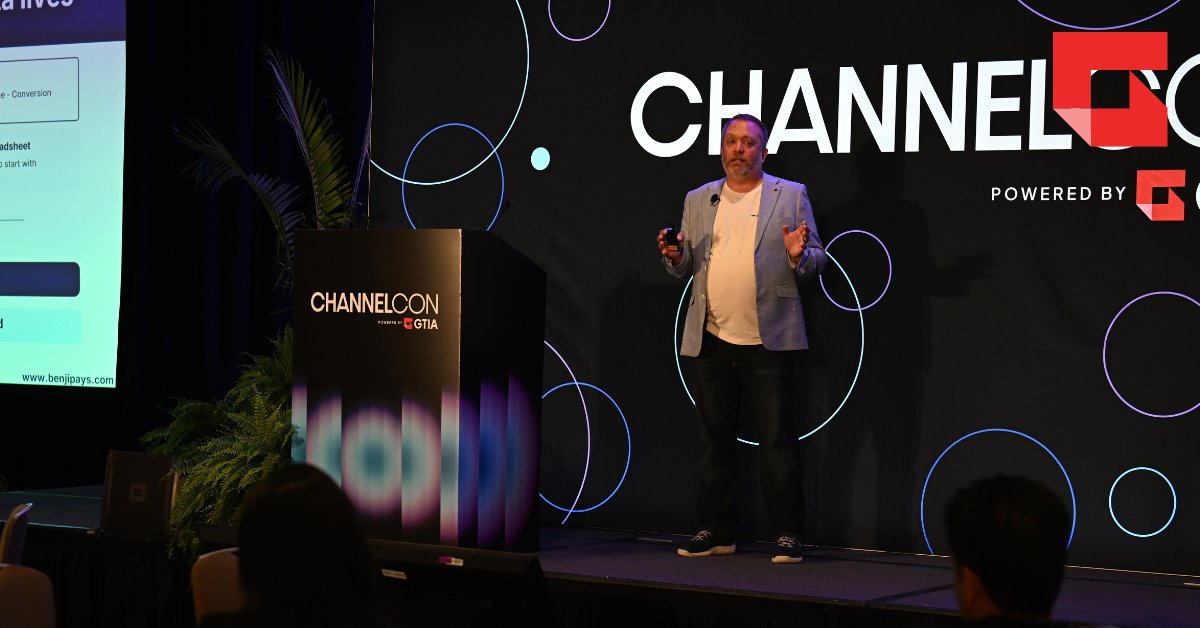
Growing an MSP takes more than adding revenue and headcount. At ChannelCon 2026, Matthew Whitehouse, founder and business advisor at BTGCO, walked attendees through why firms plateau after their first growth phase, and what leaders can do to move past it.
Growth and Profitability Aren't the Same Thing
Whitehouse opened with a distinction many leaders overlook: Growth and profitability are only weakly correlated. A firm chasing growth without a matching focus on profit takes on complexity it isn't equipped to manage.
He outlined three ways to view growth:
- Growth as an outcome: A new service line, new hires
- The outcome of growth: The positive and negative results that follow
- The growth process: Something leaders can plan for, or something that happens to them
Growth itself is episodic. Every firm hits a first growth phase, then plateaus. Firms that keep growing are the ones that change how they operate. As Whitehouse put it, growing by 50% requires changing 50% of the business.
The Productivity Trap
That plateau has a name: The productivity trap. It shows up as unplanned work, constant reprioritization and decisions that keep escalating back to the founder. Rework and quality corrections pile up. The same problems repeat because the organization never builds a system to learn from them. Margins get thinner, and collecting on them gets harder.
Research points to a common root cause: Technical founders often wear too many hats. Their strength is the work itself, not managing people around it, and delegating can feel like giving up the identity that built the company. Founders who make that shift free up the bandwidth their business needs to grow.
Why Firms Fail
Whitehouse shared a sobering but consistent statistic: 10% of companies fail every year, and that number holds steady year over year—even as roughly 11% of new companies enter the market to replace them.
Two forces drive most of these failures:
- Liabilities of newness: Gaps in managerial skill, financial acumen and network connections
- Liabilities of obsolescence: Strategic persistence, rigid processes and a widening gap between what the company delivers and what the market wants
Firms that listen to what the market wants, and adapt their processes accordingly, outlast those that hold onto what worked a decade ago. Whitehouse noted that even small changes in a firm's operating conditions can put it on a meaningfully different growth trajectory.
Three Tools MSP Leaders Can Use Now
Whitehouse gave attendees three practical frameworks to apply directly to their business:
- 1. The Founder Dependency Risk Model (FDRM): Maps where a firm sits across four states: Founder bottleneck, hero execution, overloaded founder or scalable execution system. This will illustrate how much of the business still runs through one person.
- 2. Five KPIs to track dependency and drag:
- Unplanned work ratio
- Decision escalation rate
- Rework/reopen rate
- Role utilization balance
- Learning loop closure rate
- 3. The Founder Blackout Exercise: A simple thought experiment: Imagine the founder, CEO or top executive disappears tomorrow. Who does what? How does the business keep running? What needs to get stronger and what needs to be replaced?
Whitehouse recommended starting small, one week at a time:
Week 1: Measure unplanned work and escalations
Week 2: Lock in three KPIs and define decision rights
Week 3: Standardize one critical workflow
Week 4: Run the first operating review
From Technical Founder to Executive
Whitehouse closed with the shift every scaling leader eventually makes: From heroics to standards and systems, from individual decisions to decision frameworks, from doing the work to building the capacity for others to do it, from intuition to a consistent operating cadence, and from chasing growth to governing it.
He compared it to professional poker: The same players keep reaching the final table because they've built a process around probability instead of instinct. MSPs face the same choice—build the systems that let the business run without depending on any one person, and growth becomes something the firm can sustain rather than something it survives.
Get more business building tips and resources on the GTIA Member Portal.
Not a member yet? Join now.