
Representation is not charity and inclusion is not optional. According to the GTIA North America Advancing Women in Technology (AWIT) Interest Group, the companies that thrive are the ones that hire women, keep them, advance them and tap into their power.
Women in Leadership: Just Want the Numbers?
“What does the data actually say about performance when women are in leadership and why should MSPs care?” Crystal Conkle, CMO, The 20 MSP, asked an audience at ChannelCon 2025.
Brook Lee, VP of community and channel, Liongard had an answer. 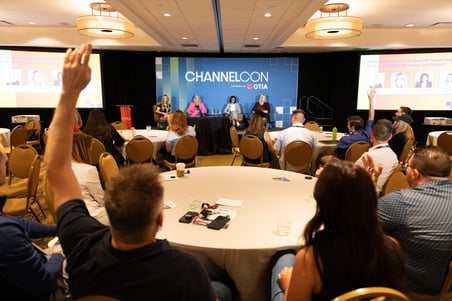
“To prepare for this question, I started doing some research. I met with Don Martin who has a PhD in finance, economics and psychology. He did his doctoral thesis on women in C-level roles that are specifically either president, CEO of IT firms, ITPs, MSPs, et cetera,” she said.
“And what he found out was that if you have women that are running that business, they are three times more profitable. They bring in three times the amount of revenue, and that's a real number. That is data that is fixed.”
She added, “His research project also showed that employees stay three times as long if the company is run by a woman. And in our space specifically, I thought that was incredibly insightful because again, we are known to have really high turnover.”
Conkle underscored Lee’s point with her own data-supported claim.
“There was a McKinsey study that showed that companies in the top quartile for gender diversity are 25% more likely to be profitable.”
Renee McCloden, global senior director of vendor strategy and programs, Pax8, agreed.
“(A recent) Forbes study was really what showed me the most powerful statistic, which is whenever you have over 30% of women in your leadership, your organization is 12 times more likely to be profitable than the top 20% in the [quartile] to perform financially,” she said.
Hiring and Advancement Pipelines: The Perspective Problem
Is the hiring challenge is a pipeline problem or a perspective problem?
“I don't think people are intentionally not looking for women,” Lee mused.
“I think it's just that they go to these same places and you have to be way more intentional—I call it widening the net. At the end of the day what we're trying to accomplish. I want you to widen the net to get more people in the pipeline.”
To that point, she gave a simple example.
“Statistically, if you get 100 resumes and one is a woman, statistically you are not going to hire that woman. You have 99 other people to pick from,” Lee said. “But if I can get more people in there and you get 200 resumes and 75 of them are women, the likelihood goes up statistically that one of those 75 women might be the best person for the role that you're looking for.”
Cynthia Mooney, enterprise global sales account manager, HP, added that organizations must be direct.
“I would argue if you are looking to change up what you have within your organization and you want more women that you need to look for the best woman, period. You cannot wait for 200 resumes and hopefully you'll get 75 because you probably won't,” she said.
She illustrated an example from HP where hiring a woman named Doreen changed the bottom line.
One of four technicians hired to support a large insurance company in New Hampshire, Doreen’s colleagues focused on help desk duties, but she spotted a recurring issue: Employees with new computers struggled for days to get set up, generating a flood of support calls.
She proposed a solution—preconfiguring the PCs in-house by installing applications and imaging them before deployment.
“We got another person for the help desk and Doreen led this program,” Mooney said. “This program ended up adding $300,000 to this account over a three-year period because she found a problem and was able to advocate for a change, which became a revenue-generating machine.”
Yes, Job Descriptions Matter
Lee emphasized that all variables need to be reconsidered, including job descriptions.
“We have examples of how to write a job description that are more general,” she said. “Maybe you need somebody that has three to four years of networking experience. If you need something specific, definitely include that. But if you built a WatchGuard firewall, I mean you can build firewalls. It’s just a different UI. So, you don't have to be super specific.”
She also pressed ITSPs to market themselves better.
“When you're writing your job description you want to sell yourself as well. That first two or three sentences are all you get to grab somebody's attention. What is it that makes your MSP special?” she asked.
Conkle linked this to applicant behavior.
“There was a LinkedIn study that showed that women only apply to jobs if they feel that they are 100% qualified for the role, whereas men apply if they feel 60% qualified,” she said.
The panelists agreed that ITSP leaders should consider putting themselves in women applicants’ shoes while arming themselves with this information.
Do You Know How Employees Are Able to Advance in Your Company?
Another important factor: Visible growth tracks.
“We need to have something that's documented and is clear to your employees,” Lee said. “Not knowing how to get from point A to point B is what causes turnover.”
“If I'm in tier one, and I've been with you for a year and I keep asking, Hey, what do I need to do? Do I need to get a certification? Do I need to do some shadowing, whatever? And we just don't have a path. What's going to happen is I'm going to go apply elsewhere.”
This may be especially true for women who might already feel like something of an outsider in what has traditionally been a male-dominated industry.
Lee shared her own story.
“I (focused on) VCIO and at that particular time I was a tier-two engineer and I that’s where I wanted to go. I kept pushing my manager. I was asking ‘what is it going to take for me to get there? What is it that I need to do to go from here to there?’” she said.
McCloden agreed.
“Having your goals, your three-year goals out there visible and communicated throughout your company so that everyone in your organization understands the direction is key,” she said.
Advocacy, Sponsorship and Mentorship
Mooney perhaps dropped the most sage advice of the panel: Mentors and sponsors make or break careers, and she contrasted two experiences: One ineffective and one transformative.
“One mentor talked about himself,” she recalled. “We met on a monthly basis. I wanted to meet more often, and I think we had three calls. Quite frankly, if he walked into this room, he probably wouldn't even know who I was.”
But her second mentor, Mike Messier, “was phenomenal and continues to be a phenomenal mentor and sponsor. He advocated for me when I wasn't in the room. And when I say not in the room, not even in a meeting that I wasn't in—he would set up calls with people in his network who he knew were in the direct line for me and for my sales role,” she said. “He didn't even wait for me not to be in the room. He advocated for me every step of the way.”
The most important action? Just make a move, even if it’s a small one. What can employers do?
Be intentional in hiring. “You have to intentionally say, I want the best woman or I want the best indigenous person or I want the best person with an outward disability,” Mooney said.
Broaden your pipeline. “If you throw it on LinkedIn or ZipRecruiter you're going to get the same results over and over again,” Lee warned.
Show women leaders in your marketing. “We always make sure that we have female keynote speakers, that we have panels who are women,” Conkle said.
Make mentorship real. “Don't force it, make it almost organic,” Lee advised.
>> Check out the GTIA Mentorship Program
Make Your Smartest Investment
“I never want somebody to hire somebody just to say, I hired this woman and I checked the box,” Lee said. “But, I want you to bring more people in so that you have an opportunity to choose from a bigger talent pool.”
Mooney rested on intentionality.
“If you want it, it's possible, but you've got to build your network. You've got to find the women where you wouldn't expect them to be, and you've got to really make sure that you build your network before the hiring rep comes along because I promise you, if you have an opportunity and you have to fill it quickly, you are going to revert back to ‘I just need the best people,’ she said. “And the ‘best people’ may not be building resiliency or diversity into what it is you want to do.”
GTIA Members: Download Organizational Strategies for Hiring, Advancing and Retaining Women in Technology in the Member Portal.
Watch the ChannelCon 2025 rebroadcast!