Most businesses will tell you that the road to success is always under construction. And while that couldn’t be truer for IT channel companies doing business in a complex and sophisticated market, the prevailing outlook is positive according to the GTIA State of the Channel 2025 report.
At the GTIA Communities & Councils Forum (CCF), Carolyn April, vice president of research and market intelligence at GTIA presented the findings of the annual report noting that the channel is feeling generally good about their business and our industry.
About half of firms feel the IT channel is healthy but remains at the status quo. April says these companies are focused on maintaining existing relationships and humming along, not necessarily on explosive growth. The other half also describes the channel as healthy, but believes it is changing rapidly. April says this indicates a desire for growth, diving into new AI opportunities and elevating around cybersecurity. Both groups have a positive outlook and are doing well, they’re just in different lanes.
Regardless of the lane your business is in right now, there are a few overarching themes that will impact your road forward this year, including a focus on services, AI adoption gains and workforce skills challenges.
 Services Lead the Way
April asked the group, when you’re in a social setting and asked what you do for a living, how to you respond to a person who doesn’t have a technical background? According to the report, 31% say they sell computer products, 37% say they sell technology services and 32% say they sell business solutions that include a tech component.
“If you asked this same question 5-10 years ago, the number of people who said they sell computer products would have been much higher,” April said. “We’re seeing a leveling out. Most channel firms today are hybrid in terms of their product category offerings and the types of services they provide to customers.”
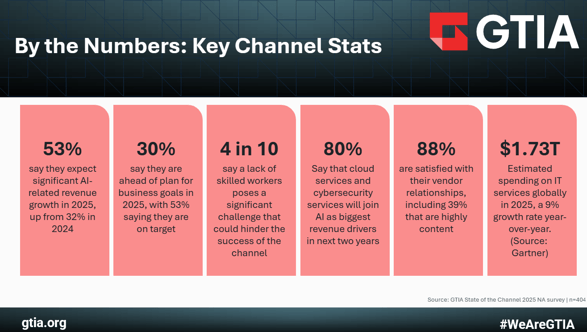
And that’s a good thing, because Gartner estimates that spending on IT services globally in 2025 will reach $1.73T, a 9% growth rate year over year. April says this will filter downstream and every channel company offering managed services and consulting services will reap the benefits.
But what particular services will lead the way this year? According to the report, the top five include:
- - IT services
- - Consulting
- - Data services
- - App, web or mobile device solutions
- - Cloud services
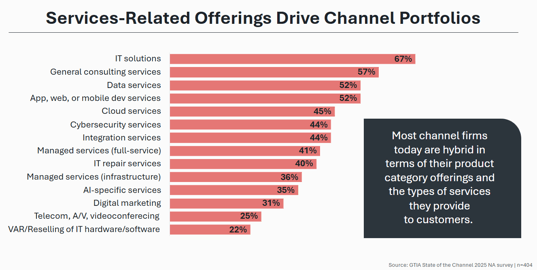
- “The thing to note about this list is that most channel companies offer a hybrid of these solutions,” April said. In fact, MSPs are more likely to identify their businesses as hybrid. Most of their revenue might come from the MSP stream of their business, but they still rely heavily on product reselling and project work.
One thing is for certain: It doesn’t matter if your business is based on products, services or business solutions. Everyone is predicting a significant increase in AI-specific services.
AI Adoption Gains on Revenue Side
After two years of tremendous hype set in motion by the widespread introduction of ChatGPT, the industry, both vendors and the channel, is starting to grasp some of the more practical aspects of the AI business opportunity as well as its challenges.
“Most of the attention the channel has paid to artificial intelligence to-date has been internal experimentations. This year we are seeing a lot of push on the revenue side,” April said.
In fact, 53% of North American channel firms say they expect significant growth in AI-related revenue for their business in 2025, up from 32% that said so in 2024. We’re finally starting to see the channel learn how to monetize AI.
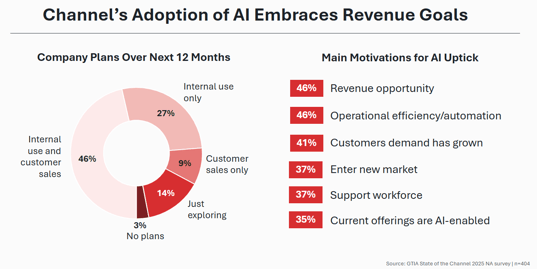
“This is the first year we’re seeing a lot of channel companies say they are going to market AI solutions—not just use them internally,” April said. “The major motivator for getting into AI right now is revenue. There’s a ying and a yang between using AI to drive sales and cut costs. If you can pull those two levers, that’s a win for your business.”
 April emphasized that the channel can play a big role here.
“Not every customer business needs to go all AI all the time,” she said. “But this can be your secret sauce. You’re the one who can discern that for your customers. Break down the pros and cons into one beautiful consulting package and help your customers move forward.”
Revenue opportunity, operational efficiency and customer demand are the big reasons the channel’s adoption of AI is accelerating. But how can you plug into AI right now? There are plenty of use cases for businesses. Your peers are using AI today in the following ways:
- - Automation (41%)
- - Content generation (35%)
- - Sales and marketing tool (34%)
- - Data services offerings (33%)
- - AI product portfolio (31%)
- - Cyber offerings (30%)
- - Consulting services portfolio (30%)
- - Inventory tracking tools (28%)
- - HR hiring tools (26%)
The takeaway? There is not one runaway winner here. Plug into AI where it makes the most sense for your business and find the right balance of using it for internal productivity and driving new revenue.
Related Content: Check out two new AI Best Practices for MSPs Quick Start Guides! How to Use a Custom LLM Writing Engine and Developing Usage Guidelines and Policies
Workforce Skills Challenges Persist
While the outlook is positive, there are still some challenges the channel is grappling with. A big one concerns the workforce. In their quest to meet today’s sophisticated demands around AI, cybersecurity, data services, vertical specialties, etc., four in 10 channel firms say they are struggling to find and compete for workers with the right skills.
“Everybody is competing for the best of the best,” April said. "But the appetite for hiring is there and channel companies are looking for people.”
With demand for AI, cybersecurity, data and project management skills at a high, many channel firms are looking for people who can oversee these complex technologies. The question is, do you build or buy? In other words, do you hire externally or develop from within?
While there are costs, advantages and disadvantages associated with both options, the channel is taking a balanced approach with 47% hiring staff for existing roles and 44% hiring staff for new roles. Additionally, 39% are investing in staff upskilling and training.
But the level of change in the skills channel companies need today is very high. Many are finding themselves hiring for a new set of skills that they may not be familiar with, and they are also competing with companies outside of the channel.
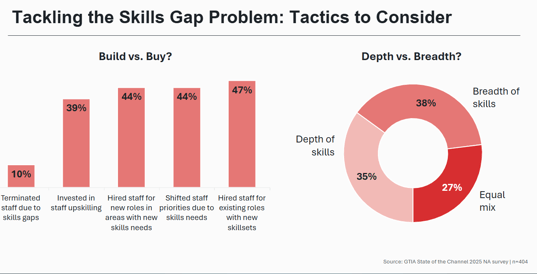 “Do you need people to be deeper at what they already do? Or do you need them to increase their breadth of skills?” April asked. “The channel is telling us that we need both.”
Thirty-five percent of companies say it’s the depth of skills requirements that have grown more insistent, so they see the need for workers in specific disciplines such as cybersecurity to take their knowledge there up a notch or two. On the flip side, 38% identified the breadth of skills that require more attention, meaning workers must expand outside their own lane and gain knowledge of other areas of the tech portfolio and tasks. The other 27% said it’s both depth and breadth of skills that require expansion, underscoring that the upheaval is happening on all fronts for some companies.
Complexity Boosts Channel Demand
As sophisticated and complex as the IT channel has become these days, it’s a place where we can all thrive. “When you think about complexity you about a negative,” April said. “You think this is hard to understand. But for those of us in this business, the more complex the challenges are, the more your customers need you.”
GTIA Members: Download the GTIA State of the Channel 2025 on the Member Portal.