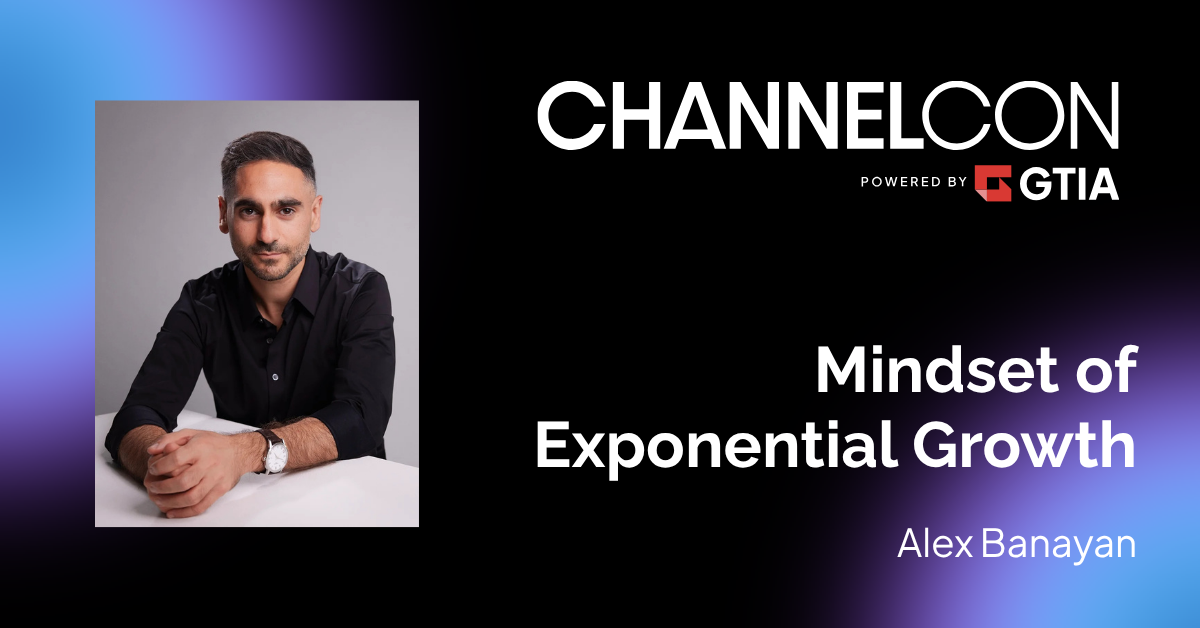
Quick answer: At ChannelCon 2026, bestselling author Alex Banayan delivered a keynote on the mindset behind exponential growth. He introduced his Third Door™ framework—the idea that there's always an unconventional way in when the main path is blocked—and the Rejection Inspection Framework, a three-step method (Reset, Realign, Reexamine) for processing setbacks without losing momentum.
Alex Banayan, the youngest bestselling business author in American history, opened ChannelCon 2026 with a business keynote built on one core idea: Your mindset drives your results, and you can change it.
Drawing on seven years of interviews with leaders ranging from Bill Gates to Lady Gaga to Larry King, Banayan showed IT channel professionals how they can navigate shifting markets, find new revenue opportunities and strengthen partnerships by rethinking how they respond to obstacles.
The Third Door: There's Always a Way In
Every industry has its front door—the crowded, obvious entrance everyone lines up for—and its side door, reserved for the people who already made it. Banayan's framework is built on a third option most people never think to look for.
There are three ways in, he explained: The main entrance where most people wait in line, the VIP entrance reserved for the already-successful, and a third door—the one you find by leaving the line and looking for an unconventional path.
That third door is how, in Banayan's telling, Bill Gates sold his first piece of software and Lady Gaga landed her first record deal. It's a framework built on the belief that when the traditional route is blocked, another way in almost always exists.
Banayan illustrated the idea with his own story. As a pre-med freshman in college who felt his path was "sucking the life out of him," he started researching how successful people actually got their start but couldn't find a book that answered the question. So, he decided to write it himself, and needed fast cash to fund the research. Two nights before finals, he won tickets to The Price Is Right and pulled an all-nighter—not to study for exams, but to study the show. He won the showcase, sold the sailboat prize and used the money to launch the interviews that became his book.
Persistence, he told the audience, showed up in nearly every interview he conducted, most obviously in his telling of himself chasing down Larry King in a grocery store until King agreed to breakfast—a meeting that would turn into more than fifty breakfasts over the next five years.
His core message? The opposite of success isn’t failure. The opposite of success is not trying.
The Rejection Inspection Framework: 3 Checkpoints for Processing Setbacks
Banayan's central argument was that persistence alone isn't the differentiator. What separates people who keep growing from people who quit is how they process rejection when it happens. He compared it to driving on a dirt road at night: You can't control the terrain, but you can decide what to do when your internal check-engine light comes on.
He outlined three checkpoints for working through a setback.
- Reset the System. The first move when facing an obstacle is a hard reset—a walk, a cup of coffee, whatever clears your head. It won't solve the underlying problem, but it creates space to think clearly enough to move forward. Of course, that doesn’t always work. And if it doesn’t, move to the next step.
- Realign the Navigation. When self-doubt creeps in, Banayan recommends writing down, in a single sentence, the reason you started your role or your organization in the first place. Tape it somewhere visible. The problem won't disappear, but it gets right-sized against your larger goal. And, if that doesn’t help you, call in a friend.
- Reexamine the Engine. The final step is bringing in a second pair of hands—a colleague, mentor or friend who can help identify the story you're telling yourself about the setback.
"The engine of the human mind is the story we tell ourselves about why something happened,” Banayan said.
He pointed to two stories people tell themselves after a setback: One about what the rejection means about them ("I'm not good enough"), and one about what it means for the future ("I'll never reach my goal"). Both are constructed by the brain without conscious awareness, and both lose credibility once someone else helps name them out loud.
Why This Matters for the IT Channel
Banayan's framework speaks directly to the pace of change IT channel professionals navigate everyday-shifting vendor landscapes, new competitive pressure and constant pivots in go-to-market strategy. His closing point reframed failure entirely: Mistakes and success come from the same source, the willingness to try. Treating rejection as data instead of a verdict is what keeps a business, and a career, moving forward.
“If you’re going to understand growth, you have to understand how success and failure interact,” he said. “It’s how you learn. Most people treat their mistakes as their biggest enemy and that’s the biggest mistake you can make. It’s only when you treat your mistakes as your best friend that you grow. Your mistakes are your greatest gift.”
FAQ
What is the Third Door framework? The Third Door™ is Alex Banayan's framework for finding unconventional paths to success when the traditional entrance is blocked or the VIP route isn't available. It's the basis for his bestselling book of the same name.
What is the Rejection Inspection Framework? It's a three-step method Banayan uses to process setbacks: Reset the System (take a hard mental reset), Realign the Navigation (reconnect with your original reason for starting) and Reexamine the Engine (talk it through with someone who can help identify the story you're telling yourself).
Who spoke at the ChannelCon 2026 business keynote? Alex Banayan, the youngest bestselling business author in American history, delivered the keynote on the mindset behind exponential growth.
What was the main takeaway from the keynote? Mindset drives results more than circumstance. The opposite of success isn't failure; the opposite of success is not trying at all.
Get more ChannelCon news and follow GTIA on LinkedIn!