From the FBI to the boardroom—and now the helm of an AI-driven talent company—Joanna Riley’s career has been defined by a willingness to look beyond the obvious. In this Q&A, the founder and CEO of Censia and GTIA board member, reflects on the moments that shaped her belief that talent systems are leaving far too much human potential on the table, why AI can be a powerful force for fairness when used responsibly and how experiences ranging from taking a company public to serving on the GTIA board sharpened her focus on trust, leadership and people-first innovation.
Along the way, Riley also shares what recharges her outside of work—and why the future of AI is ultimately a human story. Here’s what she had to say.
You’ve built and scaled multiple companies and now lead Censia with a mission to eliminate bias in hiring. What first sparked your passion for using AI to make talent decisions fairer and more equitable?
For me, it started with seeing how many exceptional people get overlooked for opportunities that they qualify for because of the limitations of traditional human capital systems. Companies have historically relied on proxies like job titles, degrees or brand-name employers, and while those signals can be helpful, they only tell part of the story. They do not fully capture someone’s skills, potential, adaptability or growth potential.
Early in my career, I worked for the FBI and learned the power of profiling. It taught me the importance of looking beyond surface-level information and recognizing that people are far more multidimensional than they appear on paper. That insight stayed with me.
Over time, I began to see the same pattern in hiring and talent decisions. We were using narrow inputs to make very important decisions, thereby missing a tremendous amount of human potential. I became convinced that AI could help us do better by identifying deeper patterns in skills, experience and potential that humans alone cannot process at scale.
That was really the foundation for Censia. I saw an opportunity to use AI to help companies make smarter, fairer decisions about their people and talent based on skills and potential, not just pedigree. For me, the goal has never been to replace human judgment. It is to strengthen it with better data, better insight and a more equitable starting point for decision-making.
Your background includes everything from working with the FBI to taking a company through an IPO, being an investor, and so much more. How have those very different experiences shaped the way you lead Censia today?
Each of those experiences shaped me in different ways, but together they teach me to lead in complex, high-stakes environments. My early work connected to the FBI taught me the value of pattern recognition, disciplined analysis and looking beneath the obvious. That had a lasting influence on how I think about talent and on how we build AI systems that identify meaningful signals in complex human data.
Taking a company through an IPO taught me how to build at scale, with rigor and accountability. It reinforced the importance of creating long-term value, building trust among stakeholders and leading with clarity during periods of intense growth and scrutiny.
Being an investor added another important lens. It sharpened how I evaluate markets, how I watch the market evolve and new technologies, how I think about differentiation, and how I separate interesting technology from technology that can truly change business outcomes.
At Censia, all of those experiences come together. We are building in a space that is both highly strategic and deeply human, so I lead with ambition and discipline while also staying grounded in responsibility. When your technology influences how people are hired, developed and advanced, trust and outcomes matter just as much as innovation.
GTIA is focused on advancing the global technology industry and the people in it. How has serving on the GTIA board influenced your perspective on the future of work and responsible AI?
Serving on the GTIA board has reinforced a belief I hold strongly: AI is forcing every company to rethink everything, especially talent. Not just who to hire, but how work gets done, how people grow and how capabilities evolve over time. That makes the future of work a leadership issue, not just a technology issue.
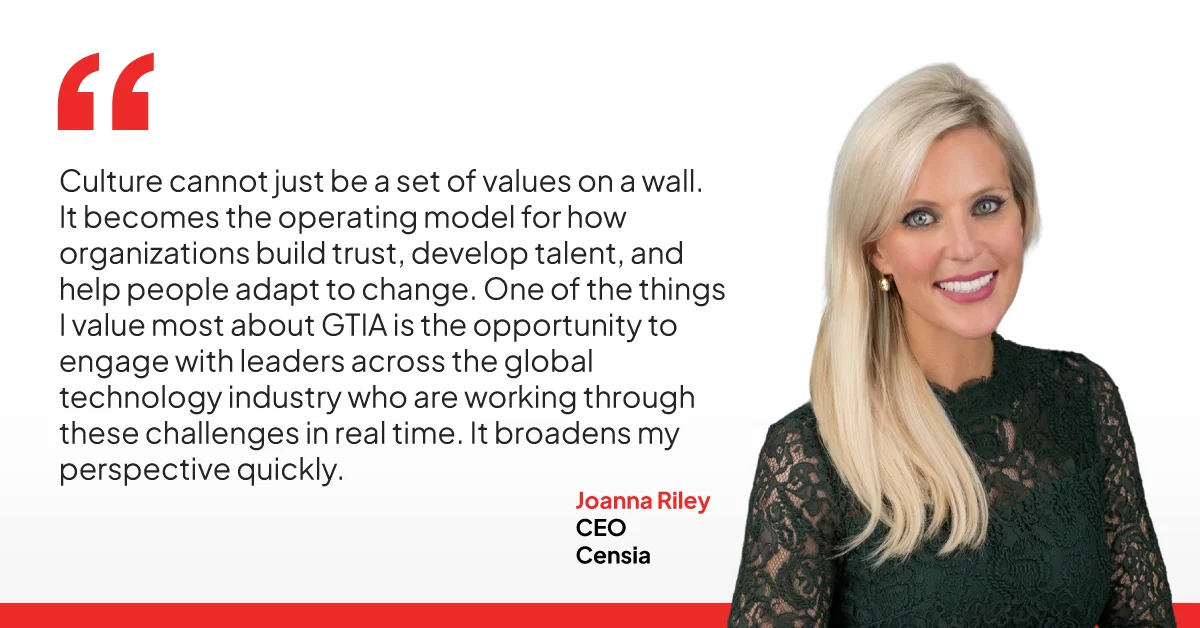
It has also deepened my belief that culture matters even more in an AI-driven world. Culture cannot just be a set of values on a wall. It becomes the operating model for how organizations build trust, develop talent and help people adapt to change.
One of the things I value most about GTIA is the opportunity to engage with leaders across the global technology industry who are working through these challenges in real time. It broadens my perspective quickly. It also reinforces that responsible AI cannot be treated as a side conversation. It has to be central to how organizations think about resilience, competitiveness, trust and long-term value creation.
As a GTIA board member, what impact are you most committed to making for technology leaders who are trying to adopt AI in a responsible, people-centered way?
What I care most about is helping leaders make AI practical, trusted and genuinely useful for people. Many organizations understand that AI matters, but many still approach adoption as a technology rollout. In reality, adoption is across every aspect, forcing us to change how we think, and it starts with leadership. One of the bigger challenges is trust. AI only scales when people believe in it. They need to understand how it works, trust the outputs and see that it helps them make better decisions in the moments that matter. That is when adoption starts to happen in a meaningful way.
I also think it is important to keep people at the center of the conversation. Responsible AI is not just about governance, although governance absolutely matters. It is also about building systems that improve decision-making, expand opportunity and unlock human potential. The impact I hope to make through GTIA is to help leaders move from theory to practice. Helping them adopt AI in an innovative, explainable, responsible and people-centered way.
When you step away from building Censia and contributing to GTIA, what’s something that brings you joy outside of work?
I love being on the water. We live near the water, so that has become a really fun part of life for our family and friends. I have always enjoyed water sports, especially kiteboarding, which is always humbling and exciting. It has become one of those activities that brings everyone together. As I learn new jumps or tricks, there is definitely a learning curve, which makes it even better. Being out on the water with family and friends, trying something new, laughing a lot and enjoying where we live is a great way to recharge. I also value time to reset and reflect, whether that is through travel, being outdoors or simply stepping back long enough to think clearly. Those moments help me recharge, stay curious and come back with fresh energy and perspective.
Meet the GTIA Board of Directors! Read the blog series.