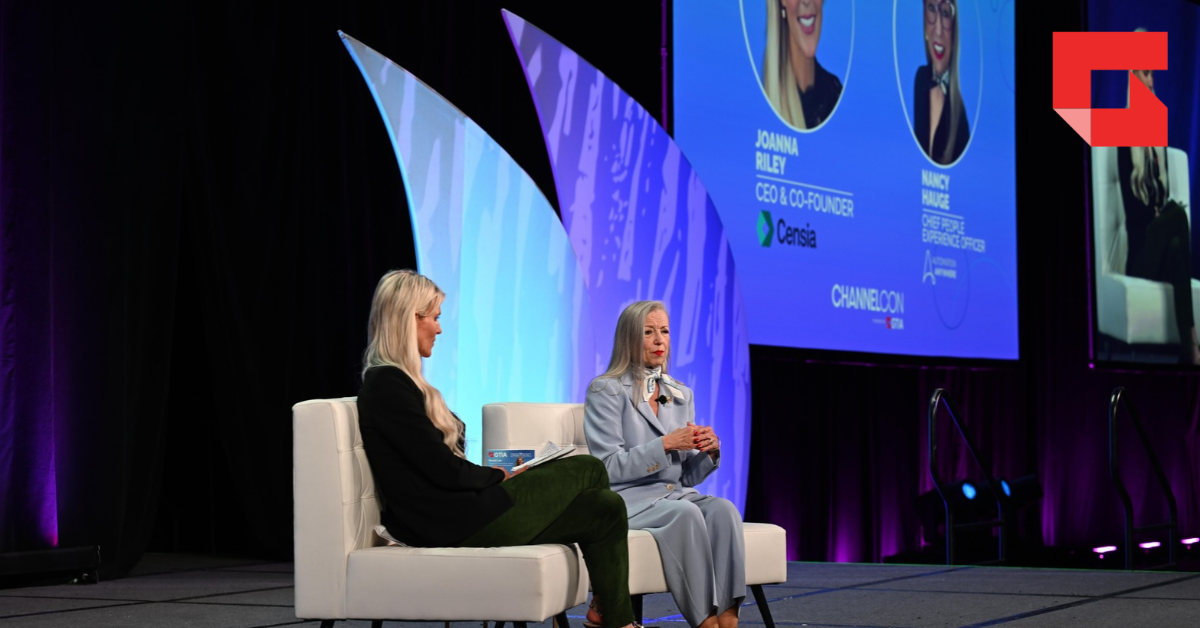
As organizations build workforces that blend people and AI agents, who will help leaders rethink how work gets done—and what role should the channel play in that transformation? Joanna Riley, CEO and co-founder of Censia, opened with that question at a ChannelCon session titled, “The Channel’s Role in the Evolving Hybrid Workforce (Humans + AI Agents).
Riley sat down with Nancy Hauge, chief people experience officer at Automation Anywhere to explore that question, among others. Hauge brought an unusually long perspective to the discussion, having helped lead people strategy through seven IPOs and five acquisitions. She also acknowledged what was maybe obvious to some in the audience, joking she was “clearly the oldest person in the building.”
She used that observation to establish credibility rather than distance herself from the conversation. After decades of watching organizations adapt to new technologies, Hauge argues that this wave is fundamentally different. Previous generations of workers learned to organize themselves around machines. AI, she contends, creates an opportunity to redesign work around people.
The Job Isn’t Disappearing. The Job Description Is.
Hauge believes many organizations are approaching AI with outdated assumptions. Companies continue to organize themselves around industrial-age management models even as the technology available to them changes fundamentally. Rather than asking how AI can replace people, leaders should be asking what uniquely human work remains once routine tasks are delegated elsewhere. That question became personal when Hauge described why she accepted her current role. Her CEO challenged her to consider what human resources becomes when a significant portion of the workforce is no longer human. The answer, she suggests, isn’t a smaller role for people leaders but a broader one.
“Computers need to be about human literacy,” she says. “That’s where we are.” In Hauge’s view, judgment, intuition, systems thinking and the ability to solve novel problems remain distinctly human strengths. AI can complete work, but people still define outcomes, make decisions and connect ideas in ways that matter to organizations. Rather than eliminating meaningful work, she argues that AI has the potential to move more employees toward it.
We’ve Been Worrying About the Wrong Workforce Crisis
Much of the public conversation around AI focuses on jobs that may disappear. Hauge believes that discussion overlooks a demographic challenge already reshaping the global workforce. Baby Boomers continue to retire in large numbers. Birth rates have declined across much of the developed world. By the end of the decade, she argues, organizations may find themselves with too few knowledge workers rather than too many. In that context, AI becomes less a replacement for people than a way to help close a growing labor gap.
“The world’s over-rotated on how do we use agents to replace people,” she says. “In five years, people are [going to ask], ‘Why did it take me so long to realize this was about growth? Not margin.’”
That distinction surfaced repeatedly throughout the conversation. AI, Hauge argues, should ultimately create capacity for innovation, customer value and growth rather than simply reducing operating costs.
The Next Competitive Advantage Won’t Be Technical
For channel partners, that shift carries its own implications. If customers increasingly adopt AI to reshape how work gets done, solution providers will have to move beyond implementing technology and toward advising on business outcomes.
Throughout the discussion, Riley steered the conversation toward what that means for MSPs, IT service providers (ITSPs) and vendors. Hauge’s answer was consistent: The partners who create the most value will be those who understand their customers’ businesses deeply enough to anticipate challenges before the first meeting begins.
“You shouldn’t have to [use up] their time having them tell you their problems,” she says. “You should actually be able to go in and say, ‘As far as I can tell, you have these three challenges. How can I help you with those?’”
That represents a different value proposition for the channel. Competitive advantage will come not simply from technical expertise but from helping customers redesign work, manage organizational change and realize new opportunities for growth. For Hauge, that’s the larger opportunity AI presents. The technology may automate routine work, but its lasting impact will depend on whether organizations use that capacity to elevate the people who remain at the center of it.